
On the surface, everything looks fine. The tests passed, the review is clean, and the junior who worked on it has shipped a dozen more this week. You scroll down a few hundred lines, and your stomach drops. The code looks careful and well-tested. But buried inside is a timing bug that only surfaces when two things occur at exactly the wrong moment. And the junior who submitted the work can’t tell you why it’s wrong, because they didn’t write it.
Across surveyed engineering organizations, juniors are now completing tasks up to 55% faster with AI assistance, and 73% of organizations have reduced junior hiring over the past two years, according to recent industry research from Octopus Deploy. JetBrains’ January 2026 developer survey put Claude Code adoption at 18% globally and 24% in the US and Canada, up roughly 6x from mid-2025. The “seniors with AI” model, in which experienced developers augmented by AI replace entire entry-level cohorts, has gone from theory to a default operating assumption in a single year.
The productivity numbers everyone quotes are real. They are also misleading.
So the productivity numbers everyone quotes are real. They are also misleading. AI coding tools have made the act of producing code much faster. They have not made the act of understanding code any faster. For senior engineers, the gap is mostly fine. They have a decade of architectural context to evaluate AI suggestions. For juniors, the gap is the entire problem.
The oversight gap in the AI era
Erik Dietrich coined the term “expert beginner” in 2012 to describe a developer who plateaus early, gets promoted into a position of power, and then poisons the team because they have stopped learning. The original framing was about ego and stagnation. The 2026 version is different. The new expert beginner is not arrogant. They’re fast, conscientious, and produce clean code that passes review. They just cannot tell you why any of it works.
The new expert beginner is not arrogant. They’re fast, conscientious, and produce clean code that passes review. They just cannot tell you why any of it works.
This is a different problem than Dietrich’s, and it shows up in a different place: code review.
“Juniors are open-minded,” says Ivan Krnic, Director of Engineering at CROZ. “This open-mindedness comes from the fact that they haven’t seen everything in this development world and haven’t picked up biases.”
This open-mindedness can be a strength, but it does create new responsibilities for the team. The same lack of experience that makes juniors fast and willing AI adopters also makes them less reliable to evaluate AI’s output. The core issue isn’t a flaw in the AI model; it is the imbalance between code generation speed and the experience required to validate it.
The most vulnerable developers may not be the juniors, but the seniors who haven’t yet integrated AI into their everyday work. By opting out, it may be hard to keep up with the patterns developing in the software. Adopting AI isn’t just about productivity; it’s about having a proper understanding of the evolving nature of work.
The talent pipeline is stalling
If you look at the current state of professional development in the software industry, there is a clear story. According to the Stanford Digital Economy Lab, U.S. entry-level tech job postings dropped 67% between 2023 and 2024. The UK tech industry saw a 46% drop in graduate roles in 2024, with another 53% drop forecasted for 2026. Octopus Deploy’s AI Pulse report found that 73% of organizations reduced junior hiring over the past two years.
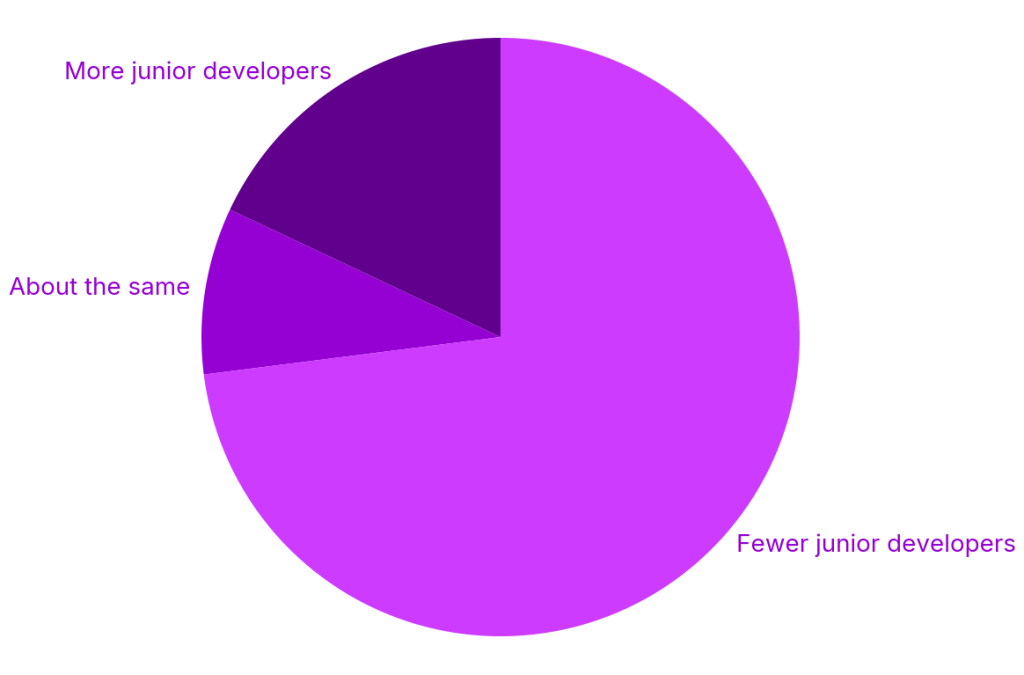
Junior developer hiring has decreased over the past two years, according to Octopus Deploy’s AI Pulse report.
This isn’t a temporary drop; the industry’s starting point is disappearing. Over half of “entry-level” roles now require several years of experience, tech internships have declined by 30% since 2023, and an increasing number of companies are prioritizing AI investment over training and mentoring graduates.
Job requirements for tech postings began to change in early 2023, shortly after generative AI tools launched. This trend has continued.
These decisions are partly financial: junior hires are not cheap, and AI tooling is cheaper than headcount and doesn’t ask to be mentored. It’s the order of events here that is worth flagging. Job requirements for tech postings began to change in early 2023, shortly after generative AI tools launched. This trend has continued, with organizations choosing AI while reducing training and mentoring budgets that should be used to produce the next cohort of experienced developers. The talent pipeline isn’t just slowing down; it’s being structurally altered.
A different kind of industry cycle
We’ve seen market contractions before, like the dot-com bust and the post-pandemic period shift. Both saw similar patterns, with reduced junior intake, emerging skills gaps, followed by senior talent shortages and wage inflation 2-3 years later.
While today’s juniors are getting their tasks done, those repetitions may not be developing the same instincts that come from working through hard problems.
This time, however, it’s more complex. Previously, the pipeline had thinned, but the nature of the work hadn’t changed. Juniors hired after those events still learned by building, breaking, and deeply understanding why failures occurred and how to solve them. AI reduces this process to a prompt and confirmation message. While today’s juniors are getting their tasks done, those repetitions may not be developing the same instincts that come from working through hard problems. If this pipeline continues to shrink and learning in the workforce is uneven, hiring alone won’t fill this gap.
Every team’s response will look different. But two questions are worth asking right now. Can your juniors explain the code they ship? Can they find a bug without AI? If the answer to either one is no, the issue isn’t that the role is being reshaped. The issue is that the engineers replacing your seniors are being trained to ship code they can’t read.
The post AI is creating a generation of developers who can’t debug their own code