Surviving in a poisoned land: Chernobyl's wildlife is different, but not in the ways you might think
19 hours agoShareSaveAdd as preferred on GoogleChris Baraniuk
 Getty Images
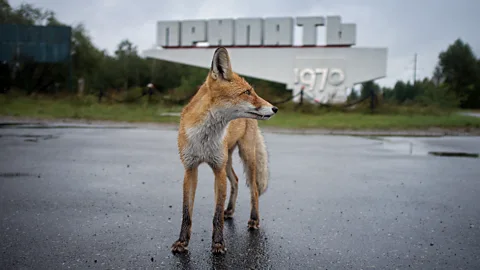
It's 40 years since the Chernobyl disaster. This is what it has meant for wildlife living around the devastated nuclear power plant.
"Pa-pa-pa-pa-pa!" In the middle of the night, a noise from the darkness in the abandoned, irradiated landscape of Chernobyl. Pablo Burraco, a scientist, stepped quietly between the trees, not far from the ruins of the power plant at the centre of the world's worst nuclear disaster. In the aftermath of the catastrophic reactor explosion in 1986, the surrounding area was evacuated for many miles, so few people trod where Burraco now did.
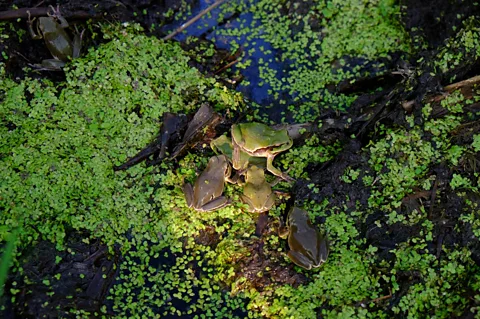
With only his head torch illuminating the ground before him, Burraco closed in on the source of the night-time racket – a tiny male tree frog, urgently calling for its mate. A swoop of his hand and he had plucked the 5cm-long (two inch) amphibian from its perch on a small tree.
It was 2016. Burraco, an evolutionary biologist at Doñana Biological Station, a public research institute belonging to the Spanish National Research Council, was making his first field trip to this troubled part of the world.
Peering at the creature now safely confined within the curl of his fingers, Burraco immediately noticed the frog was slightly dark in colour, unlike other frogs of the same species that lived further away. "It was super exciting," he says, recalling the moment. This frog raised a question that many have asked ever since the explosion at Chernobyl: had radiation from the stricken power station changed the creatures living near it? That's what Burraco wanted to find out.
Four decades have now past since Chernobyl's reactor number four exploded on 26 April 1986, sending radioactive material far and wide. Winds eventually carried radioactive dust as far as the UK, Norway and even parts of North Africa. But the landscape immediately surrounding the power plant in northern Ukraine received the heaviest dose. Intense radioactive hotspots still persist today.
Many feared the effect of such radioactive contamination would be devastating for the animals and plants living nearby. Almost all the humans in the surrounding area immediately left. These creatures could not. During the 40 years since the disaster, it has become clear that many species are living quite happily within the 37-mile-wide (60km) exclusion zone set up around the ruined power plant. But that's not to say nature hasn't changed here – sometimes for the worse.
 Timothy Mousseau/ CFF
For years, researchers have documented weird, twisted trees, swallows troubled by tumours and even an eerie black fungus that lives inside the radioactive ruins of the reactor building itself. Some creatures might have adapted to better cope with the contamination – but this idea is notoriously difficult to prove and still hotly debated. Recently, researchers have highlighted other reasons why some animals may have flourished in this injured landscape.
Genetic mutations
Burraco and his colleagues have visited Chernobyl and the surrounding areas many times over the years, sampling more than 250 tree frogs in total. In 2022, they published data indicating that frogs inside the exclusion zone were, on average, darker than those outside the zone. They focused on locations where radiation levels were particularly high immediately after the accident in 1986.
Their hypothesis, which Burraco emphasises remains a hypothesis, is that the dark colour of some frogs – attributed to higher levels of melanin in their bodies – might somehow act as a protective barrier, reducing the effects of radiation, and that darker frogs fared better in the aftermath of the nuclear disaster. But there's no hard proof of this yet.
 Germán Orizaola
One researcher, biologist Timothy Mousseau at the University of South Carolina, is critical of the tree frogs study. He says the sampling of frogs was not comprehensive enough to show a distinction between those inside and outside the exclusion zone, arguing that the occurrence of melanisation does not correlate with current levels of radioactivity around the Chernobyl disaster site.
Burraco pushes back against these points. The frogs, he notes, were sampled from a variety of areas with differing radiological exposures that are otherwise similar in terms of habitat, for example. He also notes that radiation levels have changed since the time of the accident.
Another scientist, radiobiologist Carmel Mothersill, professor emeritus at McMaster University, says the 2022 paper is "sound" in terms of its methodology and she points out that the authors are cautious in how they interpret the data.
In truth, this is a classic example of the kind of disagreement that has bubbled away for years among scientific investigators of Chernobyl's wildlife. First there is the question of responses – how do you know that some unusual feature documented in an organism is caused specifically by exposure to radiation and not, say, other contaminants in the landscape such as heavy metals, which are also known to pollute the area?
Similar debates surround reports about genetic patterns in the genomes of feral dogs living around Chernobyl, for example. There's no hard evidence that this was caused by their exposure to radiation. Studies have also shown that bank voles living in contaminated sites around Chernobyl carry higher levels of genetic diversity in their mitochondria – the tiny energy generators inside their cells – compared to those in non-contaminated areas. These differences might be attributable to mutations caused by exposure to radiation but other factors could also be at work.
A changed landscape
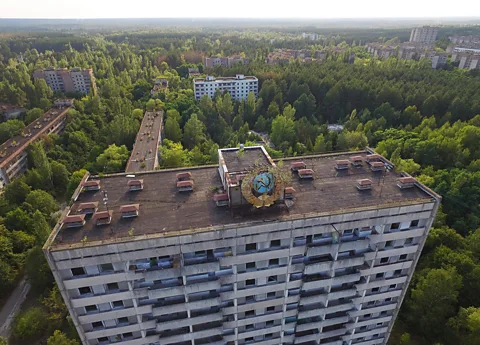
Mothersill points out that many pine trees, which are especially sensitive to radiation, died after exposure to fallout. Birch trees took over in some locations, she says, creating a completely different kind of forest: "It's teeming with trees and wildlife but it's not the same as it was before the accident." Animals living there will naturally respond differently to that changed environment and this alone, rather than radiation per se, could explain differences in those animals.
 Getty Images
One key change that may have had an important effect on wildlife near Chernobyl is the sudden withdrawal of humans.
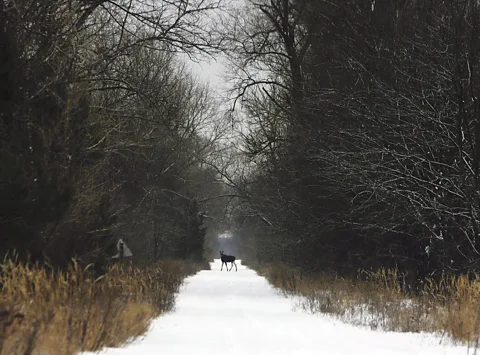
In areas once frequented by people, wolves, bears and bison now roam. Populations of deer, wild boar and elk have flourished. The number of wolves has even been estimated to be seven times higher in the exclusion zone compared to surrounding nature reserves, perhaps thanks to the abundant prey. Species including the Eurasian lynx have also returned to the area after vanishing long before the accident.
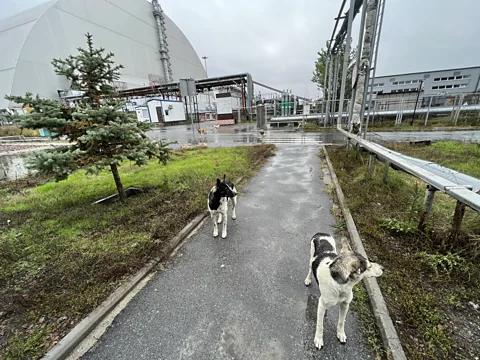
Brown bears, in particular, had not been sighted in this part of the world for more than 100 years until a camera trap caught one inside the exclusion zone in 2014. And, famously, groups of dogs apparently descended from pets abandoned after the 1986 disaster, are also plentiful in this area. Guards paid to prevent people illegally entering the exclusion zone are known to take care of these wandering canines. (Read more about the guards caring for Chernobyl's abandoned dogs.)
Adapting to survive?
Leaving the other factors aside, is it possible that plants and animals near Chernobyl have actually evolved to cope with radiation? This is one of the most controversial claims of all. Some of the unusual characteristics of these organisms could be described as true adaptations in the evolutionary sense – that is, things they have inherited and give them an edge in their environment.
There are some hints that this has happened. A 2012 study, for example, found evidence that soybeans grown in the Chernobyl area had adapted to better cope with both radioactivity and heavy metal stress. Those bank voles inhabiting Chernobyl have also been found to have greater resistance to DNA damage.
Mousseau says that the black fungus growing within the stricken reactor building, where radiation levels remain very high, seems to be benefitting from that darker colour. "That's significant, that's positive evidence supporting the hypothesis that melanin provides some level of resistance to the effects of ionising radiation," he says.
There's still no answer to the question about whether darker frogs evolved their colour as an adaptation to protect them from radiation.
But various studies have suggested that some fungi become darker as an adaptive response to radiation. Experiments carried out on the International Space Station, for example, have shown fungi do this. But Mousseau adds that, in his opinion, there is zero evidence to support the idea suggested by some researchers that the fungus has evolved to harness the energy emitted by radiation to help it grow.
For Mothersill, it's important to tease out whether mutations that emerged in plants and animals immediately after the accident have been passed down to successive generations of those organisms, even while radiation levels have fallen in the environment over time. Transgenerational mutations, if you like.
There is a hint of this in those bank voles again. Research from 2006 found that aberrations in the animals' chromosomes persisted over successive generations even when voles were taken away from Chernobyl and allowed to reproduce in a contamination-free laboratory.
 Getty Images
Certainly, not all species are thriving. Recent research has found that the combination of heat emitted from radioactive contamination and rising temperatures from climate change are together placing growing strain on barn swallows living around Chernobyl, which may make it harder for them to survive as global warming continues.
The influence of the Chernobyl disaster is far from confined to the creatures living in the immediate vicinity of the power plant. Take the edible mushrooms in Poland, blueberries sold in the US, or firewood burned in Greece that all contain very small amounts of radionuclides dispersed by the nuclear disaster that happened decades ago.
More like this:
• The true toll of the Chernobyl disaster
• Chernobyl's mysterious black fungus
• How plants reclaimed Chernobyl's poisoned land
The story of how Chernobyl has affected wildlife is complicated, argues Jonathon Turnbull, a geographer at Durham University. You can't just say nature in the exclusion zone is thriving or dying, he says: "There's the spectacular story of 'Chernobyl changed everything' – that doesn't go very deep."
Rather, there exists a menagerie of subtle effects and responses. An entire ecosystem that experienced a terrible disaster but kept living and growing. It's no surprise, says Turnbull, that so many questions still litter this landscape 40 years on.
--
For essential climate news and hopeful developments to your inbox, sign up to the Future Earth newsletter, while The Essential List delivers a handpicked selection of features and insights twice a week.
For more science, technology, environment and health stories from the BBC, follow us on Facebook and Instagram.
EarthNature & OutdoorsWildlifeEnvironmentScienceFeaturesWatch
Earth's spectacular and remote 'capital' of lightning
With storms occurring between 140 to 160 nights a year, it's no wonder the area is a world record holder.
World of wonder
The undersea mountains where sharks rule
Under the surface of the ocean, 100,000 towering mountains dot the Earth. Their violent currents are key to life.
Earth
Watch playful hyena cubs cause mayhem
A group of hyena cubs play with the other animals drawn to the fallen fruit of the sausage trees near their den.
Wildlife
Tiny lion cubs try to avoid getting crushed by elephants
Elephants going through the lion pride won't watch their step and could crush tiny lion cubs with a single step.
Wildlife
Young leopard tries to steal a meal from her own mother
A young leopard, bold but inexperienced, dares to steal a hard-won kill from her own mother.
Wildlife
Wild dogs rescue trapped newborn pups
When their den collapses, it's a race against time for this wild dog mother to rescue the youngest pups.
Wildlife
How close is too close to a hippo?
A bold leopard cub pushes his luck with a huge and threatening hippo in Nsefu in Zambia.
Wildlife
Lion saves pregnant hyena from wild dog attack
Hyena mother-to-be Tandala spots an opportunity to steal food from a wild dog pack, but she's in for a shock.
Wildlife
How can rollercoasters hold so much weight?
Rollercoasters send our hearts racing and stomachs dropping. Hannah Fry dives into the science of how they work.
Science
Watch kitten try to catch fish for the first time
Fishing cats are well adapted to water, but these kittens might need a bit more practice to feed themselves.
Wildlife
Watch as mischievous bear cub turns house into playground
Rescued from an illegal wildlife trader in Laos, a tiny sun bear cub gets a new chance at life in a sanctuary.
Wildlife
Explaining how a touchscreen works with a sausage
British mathematician Hannah Fry digs into the science of touchscreens.
Science
Watch river dolphins play with local children
River dolphins in Mocajuba in Brazil are known to play with people without guarantee of reward.
Wildlife
Hungry cub makes bold move to beat the pack
Miss too many opportunities and these young Arctic foxes could become too weak to survive.
Wildlife
Baby elephant takes a muddy tumble
Watch a funny fall turn serious as mum Cyclone steps in to protect her calf from a clumsy big brother.
Wildlife
Seven images that transformed our world view
Watch how the maps and images of our planet from above have changed over the last two millennia.
Earth
Ten striking images of an Earth scarred by humans
From a shipwrecking yard in Bangladesh to a river of iron dioxide in Canada, a deep dive in Ed Burtynsky's work.
Earth
What's inside a black hole?
Black holes are one of the mysteries of the universe where all the laws of nature as we know them stop working.
Science
Using bubbles to remove forever chemicals from our water
BBC Click visits a UK research team working on a solution to remove toxic chemicals known as PFAS from water.
Science
How sex with Neanderthals changed us forever
According to biologists, modern humans and Neanderthals shouldn't have been able to breed. But they did.
ScienceMore from the BBC10 hrs ago
Nature recovery plan launched for county
Nearly 4,000 people shared their views on how to protect local wildlife and green spaces.
10 hrs ago15 hrs ago
What it's like to drive Route 66 in an EV
As Route 66 turns 100, a growing charger network is making the Mother Road drivable by EV. But does the classic American road trip still feel the same without petrol?
15 hrs ago17 hrs ago
Bluebells: Where to find them as some bloom early
An expert explains why bluebells are flowering up to three weeks earlier than expected.
17 hrs ago22 hrs ago
How a capybara 'craze' is helping a small wildlife park stand out near Alton Towers
Keepers at Peak Wildlife Park say capybaras and polar bears are among their star attractions.
22 hrs ago22 hrs ago
'We're living in a shed because of river pollution'
Jane and Tony Coyle spent seven years waiting for planning permission due to River Lugg pollution.
22 hrs ago