At Cloud Next ’26 on Wednesday, Google filled in the missing parts of its enterprise agent platform — and shuffled a few around, too.
Gemini Enterprise is now the umbrella term for all things enterprise AI at Google, and Vertex AI has now ‘evolved’ into the Gemini Enterprise Agent Platform.
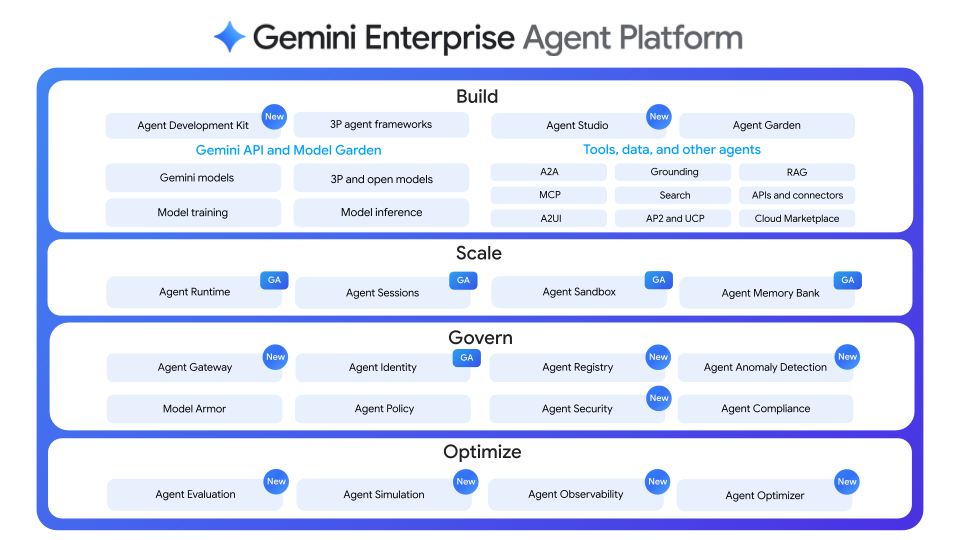
The platform, called Agent Platform, now features, among other things, the Agent Studio low-code agent builder, a simulation environment for stress-testing agents before deployment, a registry and other tools for governing them, a marketplace for third-party agents, and a semantic layer that lets agents reason across enterprise data.
There are some underlying updates that make all of this work and that Google hopes will turn Gemini Enterprise into less of a collection of (regularly rebranded) features and more of a platform. At the center of those is Anthropic’s Model Context Protocol (MCP), and agents can now work with every Google Cloud service and every Google Workspace service through MCP.
For non-developers, all of this comes together in the new Gemini Enterprise app (a web app, not a mobile app) that sits on top of the Agent Platform and lets teams discover, create, share, and run AI agents in a dedicated environment.
“Now we’re seeing, as the models evolve, people wanting to delegate tasks and sequence of tasks or workflows to agents”
Google Cloud CEO Thomas Kurian puts it this way in a press briefing ahead of the event: “Now we’re seeing, as the models evolve, people wanting to delegate tasks and sequence of tasks or workflows to agents, and these agents then being able to turn around and use a computer, use all of GCP and Workspace as a tool.”
A brief tour of the Google branding graveyard
Google has been working toward this moment for two years. Agentspace, Google’s enterprise agent product, launched in December 2024. It was rebranded Gemini Enterprise ten months later. Now, in April 2026, Gemini Enterprise is becoming what Google Cloud describes as “the end-to-end system for the agentic era, bringing together leading AI models, an intuitive UI, and a secure development framework.”
But, I hear you ask: what about Vertex AI, Google’s enterprise AI Platform? Well, the Gemini Enterprise Agent Platform is “the evolution of Vertex AI that brings together our full suite of models, development, and tuning services, with new features for businesses to build, scale, govern, and optimize agents that can work autonomously to execute complex business workflows.”
The Gemini Enterprise Agent Platform is “the evolution of Vertex AI”
All Vertex AI services and any features already on its roadmap will now be “delivered exclusively through the Agent Platform, rather than as a standalone service,” Google says. For good measure, the low-code builder inside both products, which has been called Agent Designer since it entered preview in December 2024, is now being relaunched as Agent Studio.
By Google Cloud Next ’27, we’ll likely see yet another brand name.
What’s in the Agent Platform?
Agent Studio, Google’s new low-code interface for building, testing, and publishing natural-language agents, is generally available. The product was in preview as Agent Designer since December 2024, so this is both a GA and a rename.
What may be more interesting here is what developers can now actually build with it. Agent Studio now supports scheduled and trigger-based agents, long-running workflows that span hours or days, and agents that integrate with Google services or third-party tools via MCP endpoints.
Agent Studio is a low-code visual agent builder designed to help technical teams ship agents to production faster. (Don’t confuse it with Agent Designer, which is part of the new Gemini Enterprise app — which sits on top of the Agent Platform — and is meant for knowledge workers to build agents. Make it all make sense…)
Agent Simulation is the most potentially interesting piece of the release. With this, agents can be stress-tested against what Google calls “thousands of synthetic, multi-step interactions” and enterprise scenarios before deployment, catching the kinds of tool-call failures, broken handoffs, and multi-turn context errors that don’t surface in single-prompt evals.
The idea here is to build an agent testing service that looks less like unit testing and more like rehearsing a workflow. Developers can run scenarios repeatedly against the same agent build to see whether regressions creep in before anything ships to production.
Agent Registry is a governed catalog of every agent, skill, tool, and MCP server that an organization has deployed, aimed at helping with discovery, versioning, access control, and policy enforcement.
Agent Marketplace is an expanded partner network. Atlassian, Box, Lovable, Oracle, ServiceNow, SAP, Salesforce, UKG, and Workday are offering prebuilt agents that can be installed in a customer’s Gemini Enterprise environment. Salesforce’s AgentExchange has been doing much the same since June 2025.
Universal Context is the most technically ambitious claim Google made this week, though it’s not technically part of Gemini Enterprise but rather Google’s data layer.
Gemini Enterprise now pulls from the new Knowledge Catalog, the semantic graph Google is building over both structured and unstructured enterprise data. If it works as described, it will give agents something closer to a live reasoning substrate than a more traditional vector store.
Kurian says, “We feed them business context. We call that Universal Intelligence, so all of the systems within your organization, all of the data within your company, you can use it to feed the agents with business context so they can reason on it.” It is also the tightest link between the agent platform and Google’s broader data strategy.
With this update, Google is also releasing new tools for managing agent identities, more observability features, and a new Agent Gateway.
Then there’s the previously mentioned MCP piece: every Google Cloud service and every Workspace service is now addressable by any agent through a single protocol. Which is what makes the rest of it matter.
Gemini Enterprise app
The Gemini Enterprise app is where all of this comes together. With the new Agent Designer (not the Agent Studio, that’s part of the Agent Platform), anyone in a company will be able to build new agents for process automation, Google promises. Those agents, Google stresses, will include the ability to add human-in-the-loop checkpoints and tools for inspecting and testing them. They will also get access to a new deep research agent that can execute long-running research tasks in the background.
Another feature Google emphasizes is that the service can support long-running agents for handling multi-step workflows such as financial reconciliation.
“Operating autonomously from hours to days inside Google’s secure cloud sandboxes, these agents orchestrate complex business logic in the background — powering through mission-critical work without requiring constant human supervision,” Google explains in its announcement.
For more straightforward, reusable workflows, the service also supports skills.
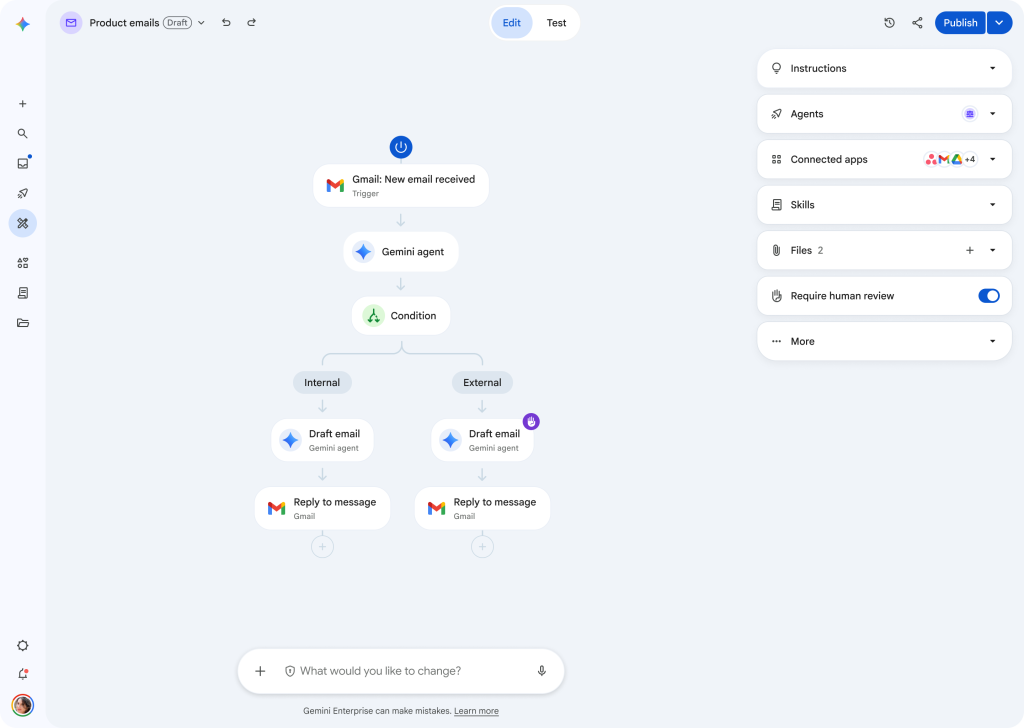
It’s also here where teams get a workspace they can share with agents. These ‘projects,’ as Google calls them, are meant to create a persistent team memory.
Finally, there is Canvas, an “interactive editor to co-create and edit in Google Docs and Slides,” because maybe the existing capabilities weren’t enough. You can export Docs and Slides as Microsoft Office files.
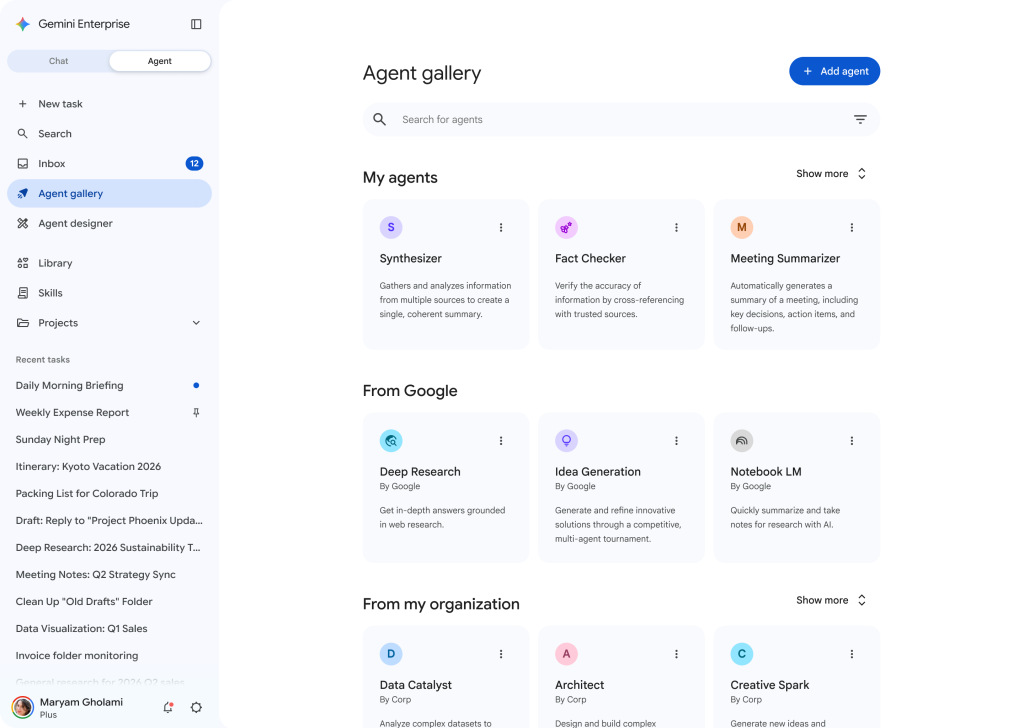
Also new in the Gemini Enterprise app is an Agent Gallery featuring Google-validated third-party agents from partners such as Adobe, Salesforce, ServiceNow, and Workday.
This app also features the new “Inbox in Gemini Enterprise,” which is, sadly, not a resurrected version of the Gmail Inbox app but, as Google describes it, “a new unified hub for managing agents at scale, including long-running agents executing complex workflows.” It’s meant to be the central command for monitoring and managing agents in the app.
As a Google spokesperson told The New Stack, having this service run in the cloud and not as a desktop app (like Anthropic’s Claude app or OpenAI’s Codex) is a major differentiator in Google’s mind.
“Unlike a traditional desktop app, this platform provides enterprise-grade governance through a single administrative ‘front door’ while sitting directly across your entire workflow to automate tasks and connect data across existing apps,” the spokesperson said.
MCP is the glue
MCP was released by Anthropic in November 2024 as a standard for letting agents call tools. In the 18 months since, it has quietly become the de facto interface for agent-to-service communication across the industry.
Google rolled out managed MCP servers for a handful of services in December 2025, starting with BigQuery, Google Maps, Google Compute Engine, and Google Kubernetes Engine.
At Cloud Next ’26, Google is also committing to fully support MCP. Every Google Cloud and every Workspace service is reachable as a tool through a single, consistent endpoint.
Kurian says, “Most importantly, we’ve also announced that all Google Cloud Platform services and all Workspace services are now available through the Model Context Protocol, so any developer can talk to any of our services, Google Kubernetes Engine, Spanner, BigQuery, just using them as a tool underneath the model of their choice.”
This means an agent built in Gemini Enterprise can now query BigQuery, spin up a Google Kubernetes Engine cluster, read a Gmail thread, edit a Google Doc, and pull a route from Google Maps, all through one protocol that didn’t exist two years ago.
The agent platform is now a commodity. Workspace is Google’s deepest moat
The agent platform, as a category, has consolidated around roughly the same set of components across every hyperscaler. That’s how infrastructure categories usually shake out.
Gmail, Docs, Drive, Meet, and Chat form a data graph no competing hyperscaler can match in breadth, and that graph is now directly coupled to the same Gemini models agents are built on.
Universal Context and Knowledge Catalog are the most technically interesting bets in this release: a live semantic graph of mixed structured and unstructured data exposed to agents. And Google’s updated TPUs, the training-optimized 8t and the inference-optimized 8i, mean the unit economics for running millions of agents at scale may favor Google.
Kurian himself says this end-to-end focus is Google’s advantage: “All the pieces underneath it are designed to do this, security to protect these agents, our data cloud to feed the agents context from within your systems, our AI infrastructure to optimize performance, scale, and cost of how agents run.”
The post Google finally builds the AI and agent platform it’s been describing for years appeared first on The New Stack.