How Kraftwerk's radical 1976 track Radioactivity became an anti-nuclear anthem
17 hours agoShareSaveAdd as preferred on GoogleArwa Haider
 Getty Images
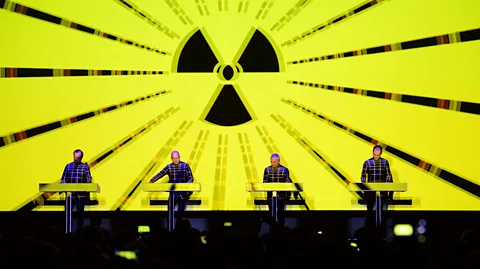
Fifty years old this month, Kraftwerk's single Radioactivity was a groundbreaking track that morphed into the German electronic pioneers' most political protest song.
From the tremulous opening seconds of Kraftwerk's Radioactivity – a pulsing Geiger counter; escalating synths; shrill morse code spelling out the title – you sense that nothing will sound the same again.
This core track from the German electronic pioneers' fifth studio album Radio-Activity (1975) feels like a scientific hymn, but it also strikes warning notes within its insistent hooks and haunting Sprechgesang (spoken singing) refrain: "Radioactivity / Is in the air for you and me".
Over the decades, Radioactivity itself has mutated, from elegiac melody to club banger and an anti-nuclear clarion call, while remaining fantastically distinctive. Half-a-century on, the album is reissued for its 50th anniversary, and this anthem still crackles with Kraftwerk's creative power.
Kraftwerk originally recorded their Radio-Activity album between bursts of transatlantic tour dates. It extended the experimental pop and deadpan wit of their international breakthrough Autobahn (1974), with lyrics in both English and German.
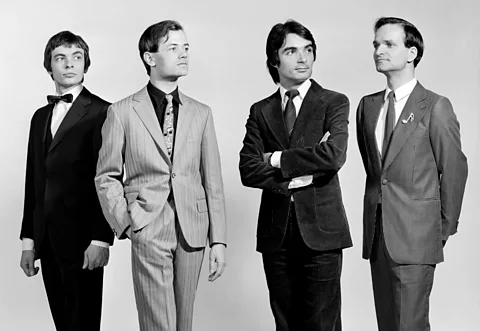
It was also a curiosity, evoking a new "information age" as well as a Cold War-era dread. It debuted Kraftwerk's "classic" quartet line-up: co-founders Ralf Hütter and Florian Schneider (who co-produced the album at the band's Kling Klang studio in Düsseldorf), Karl Bartos, and Wolfgang Flür.
I discovered Kraftwerk because they were the heroes of my heroes. It was like travelling back in time to tune into tomorrowTheir music moved into fully electronic realms, coolly detaching from Kraftwerk's earlier folky/jazzy style (where Schneider had played flute and violin); their signature synth sounds were sealed, including on the punchy Minimoog and the eerie chorals of the Vako Orchestron. Despite the album's relative brevity (its 12 tracks run to under 38 minutes), its atmosphere is intoxicating – and there is always a sense of wonder amid the tension.
"It's a science fiction kind of album," Hütter, the band's remaining original member, told Uncut magazine's Stephen Dalton in 2009. "Horror and beauty. The concept was infiltration by radio station – which is maybe more dangerous than radioactivity. We worked with tapes, editing pieces, glue. All electronics. And more singing and speaking, like speech symphonies."
'A signpost to the future'
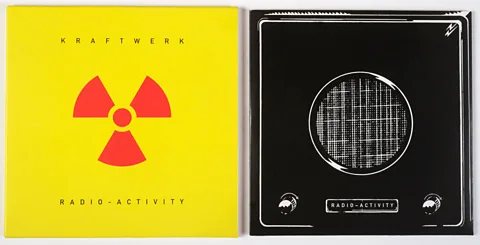
Kraftwerk's entire catalogue is a kind of extraordinary circuit board, connecting to unlimited musical styles: hip-hop; electro; ambient; new wave; synth pop; industrial rock; Detroit techno; contemporary classical. Radio-Activity particularly seized the spirit of sound and vision. The original artwork was designed by long-time collaborator Emil Schult, while the music was presented in increasingly ambitious ways: in Flür's book, I Was a Robot, he relates playing Radioactivity live using a light-triggered "percussion cage", which would frequently glitch onstage. The album has been sampled by acts including New Order (most famously on Blue Monday), The Chemical Brothers, and Miley Cyrus.
Many of the artists from my period wouldn't have existed in the way that we do now, if it weren't for Kraftwerk – Martyn WareThe band have also been cited as an inspiration by stars from David Bowie to Ryuichi Sakamoto (who once told US journalist Jim Sullivan that he'd co-founded Yellow Magic Orchestra because "we wanted to make a Japanese Kraftwerk") and the composer Max Richter (who once told me that, aged 13, he'd written to the BBC after hearing Kraftwerk on TV for the first time: "I freaked out, because I'd never heard electronic music before… I thought: 'I've got to get my hands on a synthesizer' – and then I found out a synthesizer costs as much as a house").
As music tech progressively became more accessible, it sparked further possibilities – and as a young music fan, I discovered Kraftwerk because they were the heroes of my heroes. It was like travelling back in time to tune into tomorrow.
 Alamy
Alamy"Kraftwerk are one of the pillars of my creativity," says celebrated musician/composer/producer Martyn Ware, whose own repertoire includes co-founding late-'70s/'80s trail-blazers The Human League, Heaven 17, and British Electric Foundation, as well as hosting his Electronically Yours podcast series. "Many of the artists from my period wouldn't have existed in the way that we do now, if it weren't for Kraftwerk.
"It kind of started when I met Phil Oakey [who would later become The Human League's frontman] at school; he had a much bigger record collection than me, which was an awakening. We got into Kraftwerk together, before they were even an electronic band. The thing that really changed it for me was Radio-Activity. It's conceptual art, it didn't sound like anyone else. I loved the bravery of Radio-Activity, and there's a certain gentleness, as well. It's ethereal, like there was a profound intelligence behind it all."
Growing up in the British industrial city of Sheffield, Ware adds that this music deeply resonated: "Kraftwerk's sonic impressionism painted strong pictures. They used found sound in combination with electronics, and it felt like a signpost to the future for us."
An unusually political work
By the turn of the '90s, Kraftwerk's impact on club culture was unmistakable; their dancefloor-driven collection The Mix (1991) featured recharged versions of '70s and early '80s classics such as Autobahn, The Robots and Trans-Europe Express – and a particularly radical reinvention of Radioactivity.
Whereas the original track hailed scientific innovation ("discovered by Marie Curie"), the new version was an emphatically anti-nuclear anthem ("Stop radioactivity"), opening with a vocoder roll-call of power station disasters and atomic horror ("Chernobyl… Harrisburg… Sellafield… Hiroshima"), with additional lyrics highlighting nuclear devastation ("Chain reaction and mutation/ Contaminated population").
It's really unbelievable that Radioactivity was released 50 years ago. With those high morse code pulses, half-tempo electro drums and epic synth bass, it could be a new vaporwave track – Kees BerkersRadioactivity had shape-shifted into a thrilling protest song and party anthem, emblazoned with trefoil symbols. Kraftwerk played this version live at 1992's Stop Sellafield concert organised by Greenpeace, and at UK festival all-nighter Tribal Gathering in 1997 – where I watched breathlessly as a young clubber, before racing to the nearest record shop to buy my first Kraftwerk album.
 Getty Images
The reworked Radioactivity has become a fixture at Kraftwerk's packed live shows in recent years, though it's often regarded as an unusually political work from a largely enigmatic outfit. In a 2012 live review, Rolling Stone described Radioactivity as "the band's only overt piece of activism… an all-out DEFCON 3 protest against nuclear power".
For Ware, its adaptation made absolute sense: "I think, by the time they came around to the remix album, they were totally different people," he says. "The function of an artist is to reflect the times, and to make an authentic statement based on your lived experience. So I'm not surprised at all."
The track lives on in an uncertain world
Radioactivity also arguably sounds more relevant than ever, in a modern world beset by warfare and environmental damage. In 2012, Ryuichi Sakamoto invited Kraftwerk to play the No Nukes concert in Tokyo, and Radioactivity's lyrics were expanded again, namechecking Fukushima, where a major nuclear disaster occurred in 2011.
At the time, Sakamoto explained in a broadcast for Japanese radio station J-Wave: "They [Kraftwerk] have been putting out strong anti-nuclear messages since 1991, so I thought they might sympathise with us… We exchanged emails almost every day, and I helped them a little, and we put the [Radioactivity] lyrics into Japanese. It was also the first time Kraftwerk and YMO had met in 31 years."
More like this:
• Krautrock: The '70s bands that changed Germany's image
• How the 'Red Scare' erased a US icon
• Connie Converse was a folk music genius. Then she vanished
Radioactivity remains in the air – and on-screen (it's featured on soundtracks from German arthouse movies to Brazilian telenovelas). It has been covered in a range of musical styles, from Fatboy Slim's kitsch funk reworking, to a dreamy country-folk version by Yellow Magic Orchestra's Haruomi Hosono. For new generations of artists and music fans, Kraftwerk still sound like a vital shock to the system.
"Radioactivity, and the album around it, is like a collection of sketches, experimenting with different synthesizers and sonic effects, and making new ideas out of them," says indie musician/writer Nabihah Iqbal, who will premiere her new commission for electronics and strings at Goodwood Art Foundation later this month. "The amazing thing is that even now, you can hear how that work has gone on to permeate so many different types of music. They set the blueprint for what's possible."
"Kraftwerk have such a unique approach to music," says Kees Berkers of Dutch psych-funk band Yin Yin (who have previously covered another Kraftwerk classic, The Model). "It's really unbelievable that Radioactivity was released 50 years ago. With those high morse code pulses, half-tempo electro drums and epic synth bass, it could be a new vaporwave track. Absolute game-changers!"
The modern world may feel uncertain, but Radioactivity lives on in the digital age. "Young people don't associate songs with a particular time as much anymore," says Ware. "They don't see this track as a nostalgia trip. They're listening to the DNA of their lingua franca, which is music made on a laptop."
Radio-Activity is reissued on 15 May. Kraftwerk are currently on a world tour.
--
If you liked this story, sign up for The Essential List newsletter – a handpicked selection of features, videos and can't-miss news, delivered to your inbox twice a week.
For more Culture stories from the BBC, follow us on Facebook and Instagram.
Musicmusic-historyDance musicFeaturesWatch
Ed Sheeran has already planned his posthumous album
The musician has plans to release a posthumous album and even reveals the name he has in mind.
Music
Bruce Springsteen joins surprise radio call with Sam Fender
Jeremy Allen White dials the boss live on air - then Stephen Graham gets Sam Fender to join the call.
Music
Taylor Swift shows off engagement ring
The popstar describes the proposal to Travis Kelce that broke the internet.
Film & TV
Inside the 1950s house that shaped a British rock legend
Sir Paul McCartney's childhood home in Liverpool offers a rare glimpse into the early life of a global icon.
BBC Select
Why Elton John burst into tears after recording a song
The musician explains a heavy moment thinking about the lyrics of a song from his forthcoming album.
Music
How a performance lab is putting musicians to the test
BBC Click visits a simulator lab that allows musicians to practice performance in real-world conditions.
Innovation
Listen to the 'earliest known country song' ever recorded
A wax cylinder containing the oldest recorded country song was discovered in Pennsylvania.
Music
Jennifer Lopez explains why she cancelled her tour
Jennifer Lopez explains why she cancelled her tour, and is surprised by a fan in the studio.
Music
Why Bruce Springsteen will never stop performing
75-year-old Bruce Springsteen explains why he has no plans to stop touring.
Music
What did we get wrong about Sinéad O'Connor?
Sinéad O'Connor expert Allyson McCabe on singer's flawed legacy.
Music
Frisson: Why music can give you chills or goosebumps
Why certain music can trigger a surprisingly physiological reaction.
Music
How can music help our memory?
We discover the power of music on our memories by meeting a care home resident with dementia.
Music
How can music enhance our creativity?
We explore where our musical creativity comes from, and what happens to our brains when we improvise.
Music
Can music shape us in the womb?
Why do we move to a rhythm, are we actually born to be musical, and how does music really shape who we are?
Music
How music affects our mental health
As we grow, how do we connect to music and can it help us to heal?
Music
Antytila: The rock band that swapped guitars for guns
Almost six months ago, members of the rock band Antytila joined the Ukrainian army.
Music
Joseph Boulogne: The musical genius you’ve never heard of
Music
How Fela Kuti and Tony Allen created a new genre of music
In the 1960s, Fela Kuti and Tony Allen developed a whole new genre of music: Afrobeat.
Music
The team that helps a man losing his voice sing an opera
Faced with motor neurone disease (MND), Paul Jameson is reclaiming his voice through opera.
Music
The drum born from a mystical forest
Deep in Argentina's Santigueno forest, a legendary musical instrument is made.
MusicMore from the BBC18 hrs ago
'Fatbergs' are a modern menace. Can we stop them?
Reeking coagulations of grease and debris are clotting city sewers on a colossal scale. New technologies are being used to control this modern menace.
18 hrs ago2 days ago
On the hunt for China's most famous green tea
Longjing is one of China's most revered teas. But as its traditional production has dwindled, one of the best ways to taste the real thing is to head to the hills where it's harvested.
2 days ago2 days ago
The divine visions predicting the fall of the USSR
In May 1917, three Portuguese children declared that they had seen an apparition of the Virgin Mary in a meadow. In 1992, a witness told the BBC about the "miracles".
2 days ago2 days ago
Three fun challenges to slow your brain's ageing
Our brains thrive on a challenge, but it doesn't all have to be hard work to see the health benefits. Here are three simple and fun ways to protect your brain as you age.
2 days ago3 days ago
Parents weren't always this tired. What changed?
Our ancestors probably didn't suffer as much from parental sleep deprivation, leading some scientists to reconsider guidelines for today's new parents.
3 days ago