Snowball Earth may hide a far stranger climate cycle than anyone expected
April 28, 2026 | by Krystal Kasal | edited by Gaby Clark, reviewed by Robert Egan

Gaby Clark
scientific editor
Meet our editorial teamBehind our editorial process

Robert Egan
associate editor
Meet our editorial teamBehind our editorial process

Krystal Kasal
contributing writer
Meet our staff & contributorsLearn about our editorial standards
Editors' notes
This article has been reviewed according to Science X's editorial process and policies. Editors have highlighted the following attributes while ensuring the content's credibility:
fact-checked
peer-reviewed publication
trusted source
proofread
Add as preferred source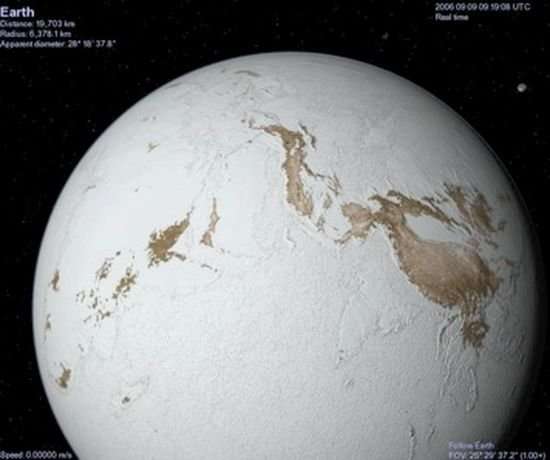
During the Sturtian glacial period during the Neoproterozoic Era, Earth underwent periods of global glaciation, which have been described as either "Snowball" and "Slushball" Earth scenarios. In Snowball Earth models, the planet was completely covered in ice for around 56 million years. In the Slushball models, portions of thin or patchy ice or even open water still existed in the tropics. However, there are some inconsistencies between these models and geological and biological evidence.
A new model, described in a study published in the Proceedings of the National Academy of Sciences, offers an explanation for these inconsistencies. Instead of consistent periods of ice, the new model suggests that cycles of glaciation and warm periods make more sense during the Sturtian period.
Issues with 'Snowball' and 'Slushball' Earth models
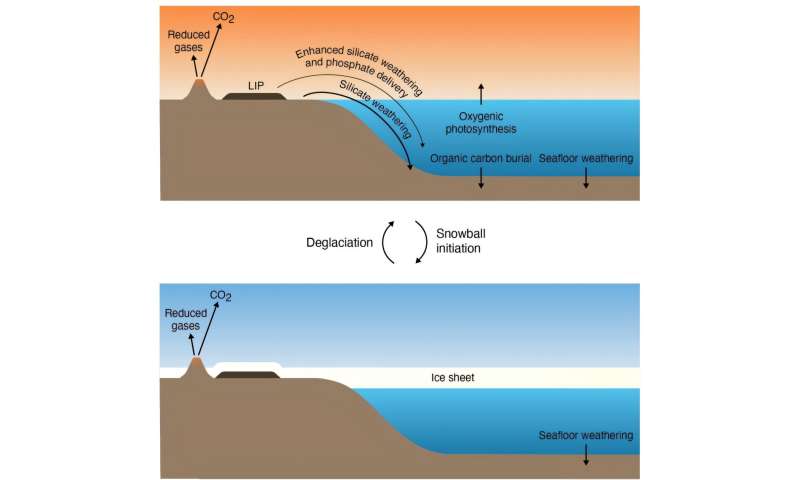
The dramatic swings in global temperature that cause periods of glaciation are linked to carbon and oxygen cycles. Another later glacial period, called the Marinoan period, only lasted around 4 million years, far less than the Sturtian. The study authors point out that silicate weathering, which acts as a carbon sink, significantly slows or even shuts down during glaciation. Then volcanic CO2 accumulates until a threshold is reached and the glaciers begin to melt. The team says that the time scale for this cycle is around 4 million years, and even lower in slushball scenarios—consistent with the Marinoan, but not the Sturtian glacial period.
Furthermore, oxygen becomes depleted during long periods of glaciation, and should be completely depleted long before 56 million years of global glacier cover. Yet, some forms of life persisted during the Sturtian glacial period.
"These mismatches between the predicted pCO2 evolution and observed glacial duration, and between the predicted pO2 evolution and observed isotopic and biological records, motivate alternative solutions to the Neoproterozoic glaciation problem," the study authors write.
The Franklin Large Igneous Province and limit cycling
To find a better fitting model for geological and biological observations associated with the Sturtian period, the researchers used a coupled box model to simulate Earth's climate, carbon and oxygen cycles. They tested a range of parameters for volcanic activity, weathering rates and the size of the Franklin Large Igneous Province (LIP). The Franklin LIP is a large igneous rock province in the Canadian Arctic, which researchers think may have helped trigger global glaciation due to significant weathering that used up much of the world's CO2.
"Enhanced weathering by LIPs has long been acknowledged as an important climate driver across geologic time. The Franklin LIP was emplaced at ∼717 Ma, essentially coincident (within 1 to 2 Myr) with the onset of the Sturtian, and could have provided a sufficiently large quantity of fresh basalt to draw down CO2 and trigger a global glaciation," the study authors say.
The team's model showed that the weathering of the Franklin Large Igneous Province triggered repeated cycles of glaciation, where CO2 would build up when LIP weathering halted during glaciation and then CO2 would get depleted by weathering again. According to the model, these "limit cycles" allowed for repeated glaciation over the observed 56-million-year duration and explain how oxygen, and thus life, could persist.
The team writes, "If only a portion of the Franklin LIP was weathered away during the initial Snowball onset, the remaining volume of basalt would still be available for weathering upon deglaciation, reinitiating CO2 drawdown during the interglacial hothouse climate until another Snowball was triggered and the cycle repeated. This cycling, back and forth between climate extremes, would continue until Franklin's weathering power (i.e. unweathered basalt) was exhausted."
While the new model is somewhat simplified and does not capture all possible biogeochemical processes, it puts forth a compelling explanation for some of the outstanding inconsistencies in the Snowball and Slushball Earth explanations. The team says that understanding how repeated Snowball episodes might occur on Earth, can also help scientists understand similar events on Earth-like exoplanets.
Publication details
Charlotte Minsky et al, Repeated snowball–hothouse cycles within the Neoproterozoic Sturtian glaciation, Proceedings of the National Academy of Sciences (2026). DOI: 10.1073/pnas.2525919123
© 2026 Science X Network
56 shares Send feedback to editors Follow us on Google News Citation: Snowball Earth may hide a far stranger climate cycle than anyone expected (2026, April 28) retrieved 1 May 2026 from https://sciencex.com/news/2026-04-snowball-earth-stranger-climate.html This document is subject to copyright. Apart from any fair dealing for the purpose of private study or research, no part may be reproduced without the written permission. The content is provided for information purposes only.Written for you by our author Krystal Kasal, edited by Gaby Clark, and fact-checked and reviewed by Robert Egan—this article is the result of careful human work. We rely on readers like you to keep independent science journalism alive. If this reporting matters to you, please consider a donation (especially monthly).
Latest stories

Twisting water reveals hidden order across four molecular layers at air-water interface
Researchers from the Department of Physical Chemistry at the Fritz Haber Institute and Freie Universität Berlin have revealed the arrangement of water molecules at the interface between liquid water and air. Their findings ...

An endurance limit that surfaces in punishing races may begin at birth
A new study is raising questions about whether human endurance has biological limits shaped long before adulthood—possibly beginning at birth. Researchers are examining whether birth weight, a known risk factor for disease ...

Integrated land planning could ease food, energy and biodiversity conflicts worldwide
While the world is a big place, humans are making greater and greater demands on the same areas of land. "This means that, unless we use the same land to serve multiple needs and coordinate this effort through planning, it ...

Small dose of antibiotic yields good results in treating panic attacks
A study shows that small doses of the antibiotic minocycline may help treat panic disorder. Experiments conducted at São Paulo State University (UNESP) in mice and at the Federal University of Rio de Janeiro (UFRJ) in humans ...

Heat and cold alter how animals fight disease. As the climate changes, this knowledge may be vital
Each animal species has an optimal temperature at which it can metabolize food and its immune system can best fight off pathogens.

DAMPE satellite reveals cosmic rays share spectral break near 15 teravolts
A century after their discovery, cosmic rays—particles of extreme energy originating from the far reaches of the universe—remain a mystery to scientists. The DAMPE (Dark Matter Particle Explorer) space telescope is tackling ...

How temperature swings impact the growth of young songbirds
Climate change threatens to cause increasingly extreme and variable temperature swings, affecting everything from urban infrastructure to global food supplies. In the animal kingdom, the hardest hit may be the youngest and ...

US may lose measles elimination status after outbreaks spread to 45 states
After public health experts declared measles eliminated in the U.S. in 2000, the U.S. Centers for Disease Control and Prevention (CDC) established seven indicators of measles elimination status to ensure that the country ...

T cells secrete DNA to boost the immune system's cancer-fighting ability
Activated immune cells secrete tiny capsules bearing DNA that can enter other immune and tumor cells to stimulate the body's defense systems, according to a study led by investigators at Weill Cornell Medicine. The discovery ...

Host genetics and sex can steer flu toward greater virulence, mouse experiments reveal
During the early stages of a pandemic, viruses tend to evolve in ways that enhance their ability to reproduce and spread, rather than to evade the host's immune system. The genetics and sex of the host influence how a novel ...
Close Your email address is used only to let the recipient know who sent the email. Neither your address nor the recipient's address will be used for any other purpose. The information you enter will appear in your email message and is not retained by Science X in any form. Your name: Your email: I would like to subscribe to Science X Netwsletter (learn more) Your friend's email: Message: Send Close What do you think about this particular story? Your feedback will go directly to Science X editors. Message: Your name: Your email:Thank you for taking your time to send in your valued opinion to Science X editors.
You can be assured our editors closely monitor every feedback sent and will take appropriate actions. Your opinions are important to us.
We do not guarantee individual replies due to extremely high volume of correspondence.
Send Close