What British people really mean when they say 'sorry'
16 hours agoShareSaveAdd as preferred on GoogleMike MacEacheran
 Getty Images/ BBC/ Javier Hirschfeld
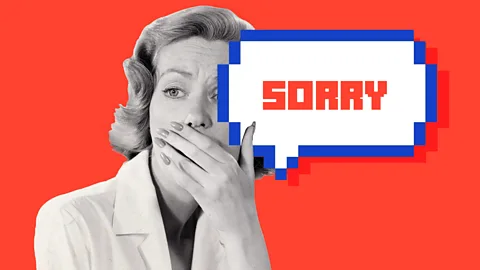
Sorry. Sorry to bother you. Sorry for the delay. Sorry about the weather. Sorry for all of the above.
In the UK, sorry is not simply an apology, it's a cultural reflex – a five-letter pressure valve used to soften requests, smooth over awkwardness, fill conversational gaps and avoid the national horror of seeming rude. It is perhaps no coincidence that such famously polite characters as Paddington and Mary Poppins are British.
Brits say the word on average nine times per day – more than 3,000 times a year. But for visitors, the puzzle is not how often they hear it, it is working out what sorry actually means. Because in Britain, sorry can mean regret. It can also mean excuse me, move over, I disagree, hurry up, you're blocking the aisle, I didn't hear you or I am trying very hard to not sound annoyed.
While these uses are not unique to the UK, the frequency, tone and the tiny social calculations often are. Britain is often known as a conflict-avoidant society, and sorry has become one of its most versatile tools – a way to manage space, soften disagreement, avoid confrontation and enforce rules without appearing openly impolite.
Essentially, sorry is a politeness code. This one word offers a fascinating glimpse into the many cultural quirks that make the Brits who they are – and for visitors, learning to decode it can be the difference between a friendly exchange and a baffling British misunderstanding.
1. "Sorry!" on the street
What it sounds like: An apology.
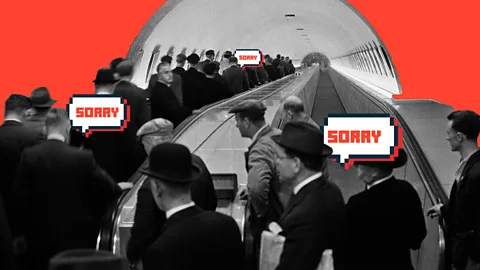
What it often means: You're in my way, I'm in your way, we have both briefly existed too physically near one another and must now neutralise the awkwardness immediately.
This is less about fault than the UK's deep discomfort with accidental intimacy: the horror of brushing a stranger's coat, blocking a pavement or occupying the same small patch of public space for a second too long.
Someone may say it when they bump into you, when you bump into them, or when neither of you has done anything wrong beyond brushing shoulders and misjudging pavement geometry. It can mean "excuse me", "after you", "please move" or "let's pretend this tiny collision never happened". The point is not blame, but social repair; a quick word that keeps things moving while sparing all involved the indignity of open confrontation.
 Getty Images/ BBC/ Javier Hirschfeld
2. "Sorry?"
What it sounds like: A request to repeat something.
What it often means: I didn't hear you – or I did, but I need a moment to process what you just said.
This beloved apology – with a subtle upward inflection at the end – is one of the English language's most useful conversational tools. It can mean "Pardon?" or "Please, can you repeat that?" or simply "I just need a second". Because "what" can sound startlingly blunt, "sorry?" becomes the softer, less confrontational alternative.
For visitors to the UK, it is handy in places like pubs and train stations with fast-moving conversations – and especially useful in areas with strong regional accents, like those from Liverpool, Newcastle and Glasgow.
Used with a cooler or more incredulous tone, however, it can shift to a distinctly British warning shot: I heard you, but I'm giving you the opportunity to rethink what you said.
3. "Sorry, can I just…"
What it sounds like: A polite request.
What it often means: I need to take up a tiny bit of space and I am apologising in advance for the inconvenience of my existence.
This is the apology of British self-minimisation. You'll hear it on trains, in cafes, at theatre seats, in hotel lobbies and anywhere someone needs to ask a perfectly reasonable question.
"Sorry, can I just squeeze past?" "Sorry, is anyone sitting here?" "Sorry, could I ask…?"
The speaker is not really sorry. They are softening the act of asking, entering, sitting, reaching or existing too visibly in public. In a more direct culture, "Is this seat free?" might do. In Britain, sorry often gets there first, as if occupying an empty chair requires a small act of contrition.
4. "Oh, sorry…"
What it sounds like: An actual apology.
What it often means: I'm objecting, but I'm going to make it sound like an apology.
This may sound like a sincere apology, but it usually isn't. In the UK, where directness can feel horribly awkward, a clipped "Oh, sorry…" is what you might hear when someone needs to reclaim their place without sounding openly confrontational. "Oh, sorry, I think I was next"; "Oh, sorry, that's my seat"; "Oh sorry, I was using that."
The apology gives the speaker cover; the pause after "oh" does the damage. It lets them object while remaining technically polite – a very British compromise between saying nothing and saying exactly what they think.
 Getty Images/ BBC/ Javier Hirschfeld
5. "Sorry, but…"
What it sounds like: A polite, throat-clearing interruption before a blunt contradiction.
What it often means: Try as I might to agree with you, I can't. I'm about to explain why you're wrong and I don't care what you think.
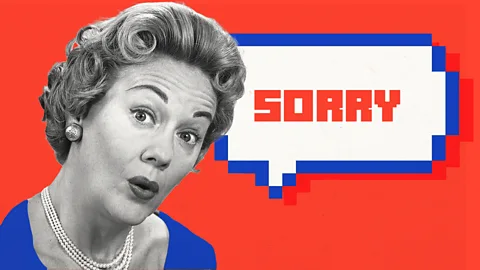
This is the pre-emptive apology: a small cushion placed before a disagreement lands. In a culture where open disagreement can feel socially abrasive, "sorry, but…" lets the speaker object while maintaining the appearance of civility.
More like this:
• How not to embarrass yourself in a British pub
• You can sleep over at Oxford's colleges - here's what it's really like
• The tiny slice of 'America' in England
It allows the speaker to challenge, contradict or correct while signalling they're not trying to start a fight – even when they are absolutely about to. Depending on the tone, it can sound conciliatory, mildly exasperated or one step short of saying "Sorry, but I'm not sorry." For visitors, the trick is to listen to what comes after the "but". In Britain, that's usually where the real message begins.
6. "Sorry…" in a queue or pub
What it sounds like: An etiquette reminder
What it often means: I'm trying not to make this awkward, but this isn't fair; you've broken the rules.
The blood runs cold at the thought of queue-jumping in Britain. Here, the queue is sacred territory – like Westminster Abbey or Wimbledon – and a politely interjected "sorry…" acts as an etiquette reminder that everyone must adhere to the rules instead of hustling for territory. In this scenario, sorry is code for "get to the back", "don't push in", "keep your distance" or "queue jump if you dare".
In the pub, the same phrase can mean "just behind you", "I think I was next" or "please don't pretend you didn't see me waiting". It's a correction dressed up as courtesy – which is often the most British correction of all.
--
If you liked this story, sign up for The Essential List newsletter – a handpicked selection of features, videos and can't-miss news, delivered to your inbox twice a week.
For more Travel stories from the BBC, follow us on Facebook and Instagram.
Know Before You GoLanguageBritish cultureCultural TraditionsFeaturesWatch
Ever caught yourself copying someone's accent? Here's why
As we speak, our brain unconsciously tweaks our speech and accent. Find out why and how that happens.
Language
The mysterious Mormon alphabet that time (almost) forgot
The Mormons launched a new alphabet in the 1850s. It was a costly failure, but now it's more popular than ever.
Language
A message from the world's oldest living culture
These ancient engraved sticks hold the memory of the world's oldest continuous living culture.
Language
Hikikomori: What drives us to withdraw from society?
Do we need to isolate in order to regenerate and reconnect with the self?
Language
Naag Nool: The women embracing an iconic Somali phrase
We meet the women embracing an iconic Somali word.
Language
Nalingi Yo: Why the word 'love' holds so much power
Rachel Isabel Mukendi explores the power that love holds and the meaning in her language Lingala.
Language
Oachkatzlschwoaf: The word that's 'impossible' to say
Can you say 'oachkatzlschwoaf'? Nenda Neururer explores her changing relationship with the German word.
Language
How women are penalised for their emotions
Why are certain emotions judged differently if they're expressed by a man or a woman?
Language
The long-lost words that perfectly describe your feelings
A compilation of little-known words for your feelings.
Language
Are these the unluckiest words in the world?
Etymologist Susie Dent charts some of globe's least-loved words.
Language
How a US island kept hold of its 17th Century dialect
Ocracoke Island in North Carolina has only been accessible by boat for centuries, creating its own unique brogue.
Language
The art of mashing up words to invent new ones
How English speakers fill gaps in their language with genius new word mash-ups.
Language
Words that reveal if you are an extrovert or an introvert
Hyperbole is now a 'mega' part of the English language, but why did it happen?
Language
US English: Why do Brits hate it so?
The British sometimes have a few bugbears when it comes to US English spellings, but is it justified?
Language
Nouchi: Why the future of French is African
How forcing a colonised people to speak the colonisers' language backfired in Africa.
Language
The perfect insults you’ve never heard of
Two labels that are five centuries old, but the individuals they describe are still instantly recognisable.
Language
The happy history of the word ‘cheers’
When it comes to raising a glass to toast good times, the word ‘cheers’ is never far away.
Language
The strange world of collective nouns
Few areas of language get people talking quite as much as the
Language
The surprisingly literal story of stealing someone’s thunder
Why the phrase stealing someone’s thunder comes from London’s theatre district.
Language
The birth of a new language
How deaf children in Nicaragua invented a completely new sign language.
LanguageMore from the BBC17 hrs ago
The Bruce Willis flop that became a cult hit
When Hudson Hawk was released 35 years ago, it was "savaged" by critics and was "notorious for its behind-the-scenes chaos". How did it build such an enthusiastic following?
17 hrs ago18 hrs ago
How to stop AI from turning your brain to mush
GPS ruined our sense of direction. Search engines weaken our memory. AI, scientists warn, could do the same to everything from creativity to critical thinking.
18 hrs ago2 days ago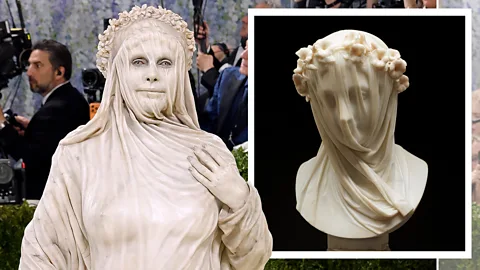
The artworks that inspired eight Met Gala looks
From Heidi Klum as a veiled Vestal virgin to singer Ciara as a gold-encrusted bust of Nefertiti, here is the art behind the fashion at the Met Gala.
2 days ago2 days ago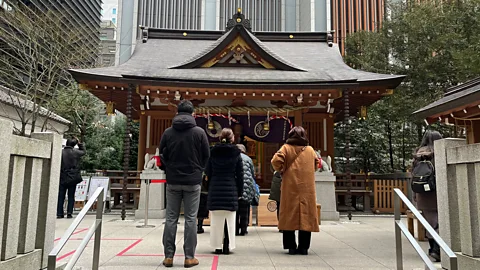
The shrine where people pray for concert tickets
Hidden in the buzzing Nihonbashi district, this more-than-1,000-year-old shrine is believed to hold the power to let you see your favourite bands up close.
2 days ago2 days ago
Why Mary Bennet is the Austen heroine for today
Based on the novel The Other Bennet Sister, a new TV imagining of Mary Bennet's life has won the hearts of British viewers. Here's why this Austen character is so relatable today.
2 days ago