Malware research group vx-underground, which says it has the largest collection of malware source code, said in a post on X that its archive of data amounts to about 30 terabytes.
A reply by Bernardo Quintero, founder of VirusTotal, an online service that scans files for malware across multiple antivirus engines at once, said his service has about 31 petabytes of malware samples that users have contributed to date. (A petabyte is ~1,000x larger than a terabyte.)
In both cases, that’s a lot of data. For context, cybersecurity companies, AI researchers, and threat intelligence firms treat repositories like these as critical for training detection models and understanding how attacks evolve. But this had us wondering: What would these enormous datasets actually look like stacked as hard drives one on top of the other and side by side? And how would they compare to, say, the Eiffel Tower?
Someone in our newsroom asked an AI chatbot this question, and it got it incredibly wrong.
Instead, we did some rough back-of-a-napkin math to figure out how tall these data banks would be. Since vx-underground and VirusTotal both have “about” that much data each, “about” is good enough for us in this case.
Let’s say we’re using 1 terabyte capacity internal hard drives, since these are generally designed to be the same physical size to fit inside any computer. These standardized 3.5-inch internal hard drives are 1 inch in height, which for the sake of stacking one on top of the other is really what we want to know here.
We’re also assuming that the hard drives we’re using in this example are exactly 1 terabyte, because in reality the total usable file capacity of a hard drive is generally somewhat less.
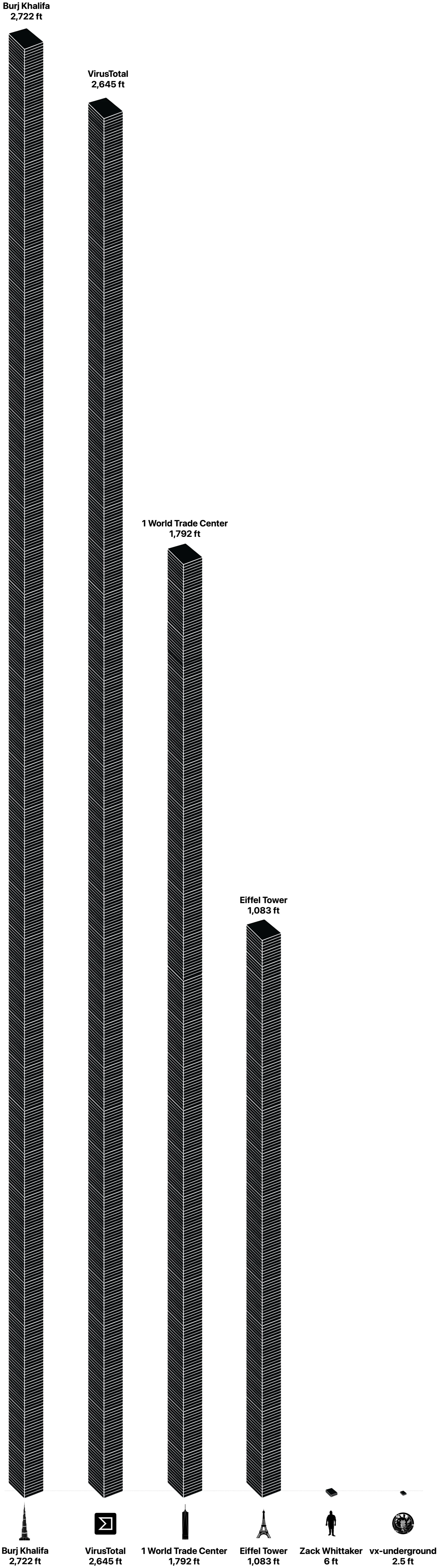
Using this online conversion tool, it looks like vx-underground’s 30 terabytes of malware data could fill 30 hard drives stacked on top of one another, reaching 30 inches, or about 2.5 feet tall.
For reference, this reporter is 6 feet tall. (See visual below, and yes, terrible opsec, I know.)
With that same logic, VirusTotal’s 31 petabytes of submitted data would fill 31,744 hard drives, which stacked on top of one another would reach about 2,645 feet.
The world’s tallest building, the Burj Khalifa in Dubai, is slightly taller at 2,722 feet.
The Eiffel Tower is 1,083 feet tall. By that logic, VirusTotal has about two and a half Eiffel Towers’ worth of data.
Topics
cybersecurity, infographic, malware, SecurityWhen you purchase through links in our articles, we may earn a small commission. This doesn’t affect our editorial independence.
 Zack Whittaker
Security Editor
Zack Whittaker is the security editor at TechCrunch. He also authors the weekly cybersecurity newsletter, this week in security.
He can be reached via encrypted message at zackwhittaker.1337 on Signal. You can also contact him by email, or to verify outreach, at zack.whittaker@techcrunch.com.
View Bio
StrictlyVC Athens is up next. Hear unfiltered insights straight from Europe’s tech leaders and connect with the people shaping what’s ahead. Lock in your spot before it’s gone.
-
AI voice startup Vapi hits $500M valuation after winning Amazon Ring over 40 rivals
- Jagmeet Singh
-
Amazon launches 30-minute delivery across the US
- Sarah Perez
-
Fintech startup Parker files for bankruptcy
- Anthony Ha
-
Laid-off Oracle workers tried to negotiate better severance. Oracle said no.
- Julie Bort
-
San Francisco’s housing market has lost its mind
- Connie Loizos
-
Cloudflare says AI made 1,100 jobs obsolete, even as revenue hit a record high
- Julie Bort
-
US defense contractor who sold hacking tools to Russian broker ordered to pay $10M to former employers
- Lorenzo Franceschi-Bicchierai